We also share information about your use of our site with our social media, advertising and analytics partners who may combine it with other information that you’ve provided to them or that they’ve collected from your use of their services.


A Configuration Guide to Central Locking Caster
The mobility and stability of a hospital bed are critical factors in ensuring patient safety
and improving nursing efficiency. A central locking caster system offers superior convenience
and security by allowing a single pedal to simultaneously lock or release all the casters.
However, to achieve optimal performance, a thorough understanding of caster configurations
and the differences in their core component—the central locking stem—is essential.
The Core of the System:2FT vs. 2OP vs. 3FN
The braking function of a medical caster is the foundation of its safety features.
Central locking casters offer different braking modes based on their internal actuator mechanism,
with two-function and three-function designs being the most common.
1)Two-Function Braking: The Key Difference Between 2FT and 2OP
Two-function casters provide two fundamental states: "Swivel" and "Total Lock."
The Total Lock function engages both the wheel brake and the swivel lock,
completely stopping the hospital bed from moving.
The primary difference lies in their internal structure:
◆2FT (2-Function with Neutral Gear)
This caster type features a "Neutral Gear" in its mechanism.
This neutral function serves as a crucial foundation for functional upgrades.
If a directional lock is needed in the future, this gear allows the caster to be modified
into a three-function (3FN) system.
◆2OP (2-function Only, No Neutral Gear)
This caster type has a simpler design, specifically without a neutral gear.
It provides only the essential "Swivel" and "Total Lock" functions and cannot be upgraded
to include a directional lock. Its advantage lies in its straightforward construction,
which can be more cost-effective.
2)3FN (3-function): Swivel + Total Lock + Directional Lock
Building upon the 2FT design, the 3FN caster adds a critical "Directional Lock" function.
In this mode, the swivel is locked in a straight-line orientation (either forward or backward),
but the wheel can still roll freely. This feature is invaluable for moving beds over long distances,
such as down hallways, as it significantly improves maneuverability and efficiency
by maintaining a straight path.
How to Configure Hospital Bed Casters: A Comparison of 3 Common Schemes
A standard hospital bed is equipped with four casters. By combining casters with different functions,
you can have the perfect balance between safety and cost.
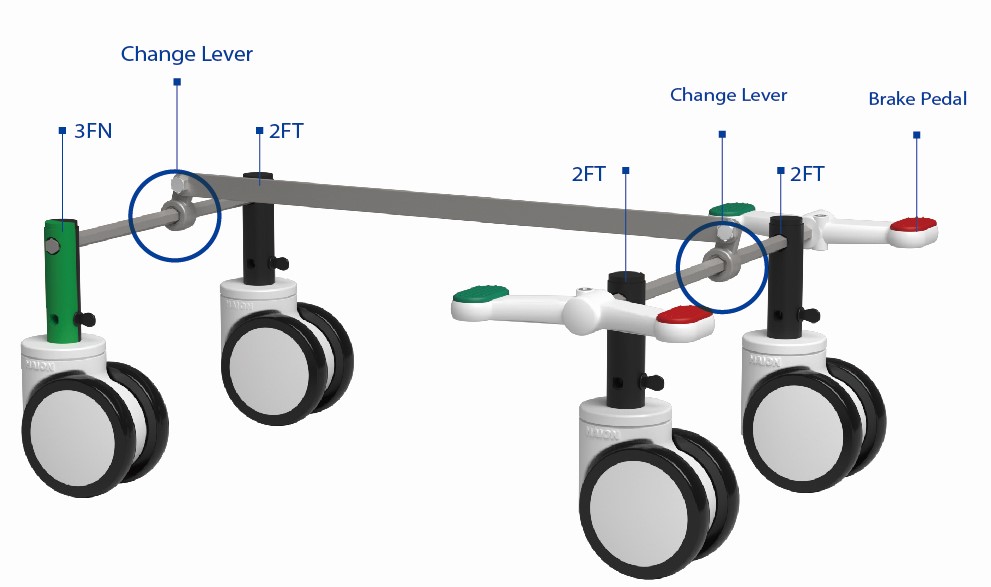
1)Scheme A (Optimal Steering): 3 x 2FT Casters + 1 x 3FN Caster
This is the most highly recommended configuration for steering and directional control.
With just one 3FN directional caster acting as the "steering guide," the entire bed can be
moved in a straight line with ease. The other three 2FT casters provide robust support and
complete locking capability.
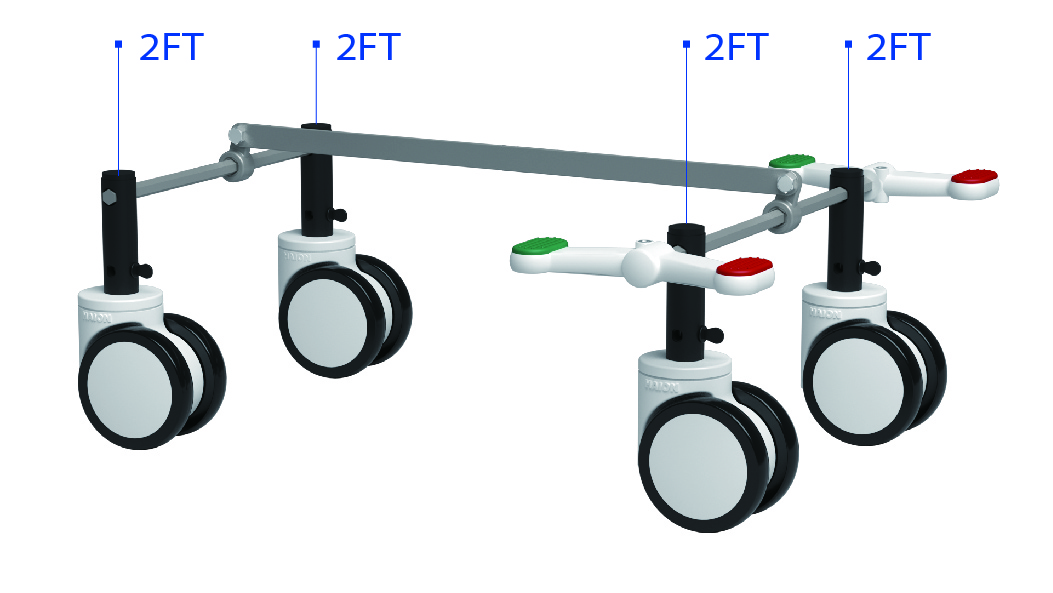
2)Scheme B (Standard Total Lock): 4 x 2FT Casters or 4 x 2OP Casters
This scheme prioritizes maximum stability when stationary. When purchasing,
the choice depends on whether future flexibility is needed:
◆Option 1: 4 x 2FT (with Neutral):
Provides the most secure locking while retaining the possibility of upgrading to
include a directional lock in the future.
◆Option 2: 4 x 2OP (without Neutral):
Offers the same powerful locking with a simpler, cost-effective design,
ideal for applications where long-distance movement is not a concern.
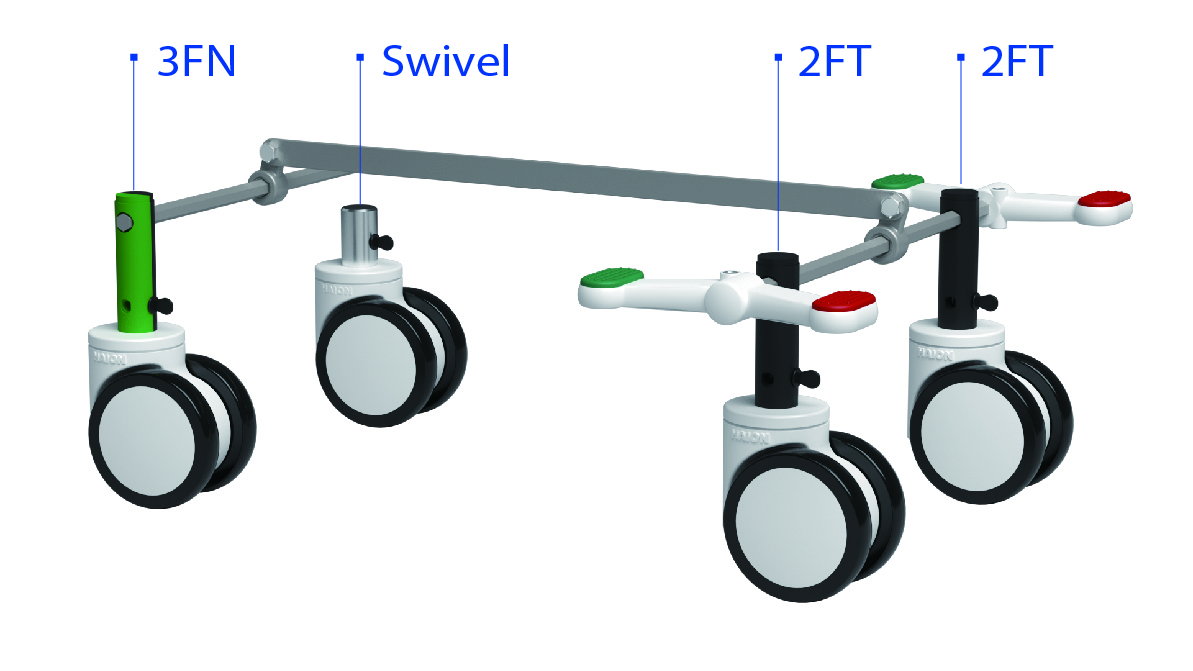
3)Scheme C (Economical Steering): 2 x 2FT Casters + 1 x 3FN Caster + 1 x Swivel-Only Caster
This is a budget-conscious choice for achieving directional control.
It retains one 3FN caster for steering and two 2FT casters for essential braking,
paired with one swivel-only caster to reduce the total cost.
Central Locking stem Specs (1A vs. 3A)
The central locking stem is the key component that links the pedal to the casters.
Its specifications directly impact the user experience for healthcare staff.
1)Actuator Rod Dimensions
◆1A Central Locking stem: 28 x 96 mm (slim and long profile)
◆3A Central Locking stem: 32 x 50 mm (stout and short profile)
◆Swivel stem: 2A (28x45 mm) / 4A (32x45mm)
2)Brake Pedal Actuation Angle
◆1A Central Locking stem: Requires a 45-degree pedal press. The pedal travel is longer.
◆3A Central Locking stem: Requires only a 30-degree pedal press.
The shorter travel makes switching between modes faster and requires less effort.
Making the Right Choice for Your Medical Equipment
Selecting the ideal central locking caster system for a hospital bed is a professional decision that
balances operational needs, safety requirements, and budget. Every detail matters—
from understanding the functional differences between 2FT (with Neutral), 2OP (without Neutral),
and 3FN casters, to choosing the right configuration scheme (A, B, or C), and finally,
to considering the user-friendliness of the 1A versus 3A Central Locking stem.
A comprehensive understanding of these elements will empower you to make the safest and
most efficient choice for your medical equipment.
HAION CASTER INDUSTRIAL CO., LTD.
Head office : 9F-5, No.27, Lane 61, Sec.1 Kwangfu Rd., Sanchong Dist., New Taipei City, 241 Taiwan
Tel : +886-2-2999-8831
Fax : +886-2-2999-9131
Email : [email protected]
Get our newsletter
Subscribe